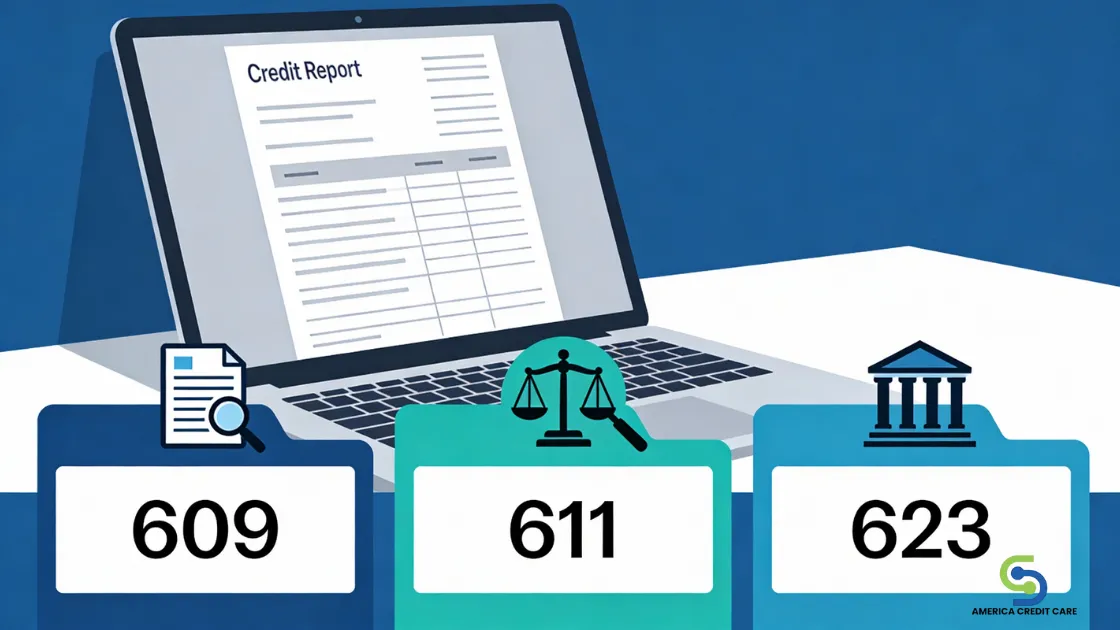
609 vs 611 vs 623 Disputes: When to Use Each
For most Americans, a credit score isn't just a three-digit number; it’s the difference between a 3% mortgage and a "denied" stamp. For many others, it could mean paying a few hundred or thousand dollars more (or less) on interest each year.
Behind this number lies a complex, automated machinery that handles billions of data points every month.
When a part of this machinery misinterprets or misrepresents your credit information (e.g., a late payment that never happened or a debt that isn't yours), you need more than just a letter to knock off an error from your credit report. You need to understand the gears.
Book Your FREE Personal Credit Consultation Now!
To win a credit dispute, you have to understand the "language" the bureaus speak. Major credit bureaus don't rely on human investigators; they use a system called e-OSCAR and a reporting language called Metro 2.
Most people assume a “609 letter” to be a shortcut that erases bad credit. In reality, sections 609, 611, and 623 of the Fair Credit Reporting Act (FCRA) give you three different tools.
You just need to know which one to use, and when.
The section 609 request: What it actually does
There’s a huge misconception that a 609 letter "forces" a deletion because the bureau doesn’t have your original signature.
You might even see “609 dispute letters” marketed as an effective legal hack that forces deletion if the bureau cannot show you a signed contract. That is a common myth related to credit repair.
Section 609 of the FCRA actually governs your right to disclosures. It says the credit bureaus must provide you with all the information in your file and the source of that info.
Under 609, here is what you can request from a credit bureau:
A copy of your credit file
The sources of the information (which companies or data providers furnished it)
Certain details about who has accessed your report
The CFPB in 2024 emphasized that credit bureaus must provide you meaningful disclosure of what is in your file and where it came from. This is helpful when you are trying to trace which furnisher, using Metro 2, may have misreported your data. Thus, a 609 letter can help you gather information so you can:
Confirm whether an account is actually yours
Identify which lender or collector is furnishing the data
Prepare a stronger, targeted 611 or 623 dispute if something is wrong in how it is reported under Metro 2 codes
It is advisable to use a 609 request when:
You see an account you do not recognize and need more detail before submitting a credit dispute
You suspect identity theft or a mixed file
You need to know exactly who is reporting a specific item using Metro 2 so you can go after the right party under sections 611 and 623
You suspect a debt collector has "sloppy" records. If the bureau can’t produce the source or the documentation required to verify the data, they may have to remove it.
Book Your FREE Personal Credit Consultation Now!
The section 611 dispute: Your right to dispute errors with bureaus
Section 611 is the backbone of your right to dispute credit report errors. It lets you challenge any information you believe is inaccurate, incomplete, or not verifiable with the bureaus.
Once you or a credit restoration service provider files a 611 dispute on your behalf, the bureau must:
Conduct a reasonable re-investigation
Usually complete it within about 30 days (45 if you used a free annual report)
Forward your dispute and evidence to the furnisher
Correct or delete information that is inaccurate or cannot be verified
This is where the automated “machine" kicks in.
When you send a 611 dispute, the bureau doesn't usually call a human at the bank. Instead, they use a system called e-OSCAR (Online Solution for Complete and Accurate Reporting).
From a system perspective, here is what typically happens when you dispute under 611:
You send a dispute (online, by mail, or phone).
The bureau translates your dispute into an ACDV (Automated Credit Dispute Verification) entry in the e‑OSCAR system. The bureau essentially converts your letter into a 3-digit code (like "Account not mine" or "Incorrect balance").
The ACDV is sent electronically to the furnisher that reported the item.
The furnisher checks its records, updates or confirms the information using that ACDV, and may also send an AUD if a broader correction is needed.
The bureau updates your file based on the response and notifies you of the result.
If the furnisher responds incorrectly or barely looks, the end result can still be wrong. So, precise disputes, good documentation, and sometimes escalation are important.
This is the reason why so many consumers with errors on their credit reports choose to hire legitimate credit repair companies like AMERICA CREDIT CARE for systematic credit repair.
Courts and the CFPB have made clear that quick “rubber‑stamp” investigations are not good enough. The process must be genuine and responsive to your specific claims.
But, you (or credit repair specialists working on your behalf) do need to understand how to use ACDV, AUD, and various FCRA provisions to your advantage.
It is useful to file a 611 dispute when:
The information is factually wrong (balance, dates or status)
The account is not yours or involved in identity theft
A paid account still shows as unpaid
An item is reporting past the legal FCRA time limit
Book Your FREE Personal Credit Consultation Now!
The section 623 dispute: Going straight to the source
Section 623 governs the duties of furnishers, such as the banks, lenders, collectors, and others that feed data into the credit system using Metro 2. This section mandates that information furnishers:
Report accurately and correct known errors
Investigate disputes they receive (from bureaus or directly from you)
Update the bureaus when information changes
When a furnisher receives a credit dispute file, either from a bureau (via ACDV) or directly from you, it must conduct an investigation, review all relevant information you provided and report results back to the bureaus.
They are bound to correct or delete inaccurate or unverified data. Furnishers use AUD (Automated Universal Dataform) to update all bureaus consistently.
So, if the bureau tells you, "We checked, and the bank says it's correct," but you know it’s not, you can bypass the bureau and go to the bank's executive office or dispute department.
Under 623, they have a legal duty to provide accurate information.
If a creditor realizes they made a mistake during a 623 dispute, they use an AUD to proactively tell all three bureaus to fix the error at once.
Direct vs indirect disputes under 623
Indirect dispute: You dispute with a bureau under 611. The bureau sends an ACDV via e‑OSCAR to the furnisher. This communication triggers the furnisher’s duty under 623(b) to investigate.
Direct dispute: You decide to write directly to the furnisher. This communication can trigger duties under 623(a)(8) and 623(b) to investigate and correct their Metro 2 reporting for your account. Both paths can work. You can use both strategies when you have ample documentation or evidence to support your claim.
When a 623 dispute is useful
You already disputed with a bureau and the result is still wrong
You have strong evidence the lender or collector’s internal records are mistaken
The issue is clearly about how a particular furnisher is reporting (for example, coding a 90‑day late when you were never that late)
Common Mistakes to Avoid
Assuming 609 letters erase valid debt: Section 609 is about disclosure, not guaranteed deletion of accurate, well‑documented accounts.
Sending vague, copy‑paste disputes: Generic form letters that do not match your financial data/actions can be treated as “frivolous” by bureaus and furnishers. This is why DIY credit repair enthusiasts fail so often.
Ignoring how Metro 2 and e‑OSCAR work: If your dispute does not clearly point to a specific error (wrong code, wrong date, wrong status), the ACDV the furnisher receives may not lead to a real fix.
Not keeping records: Always save copies of letters, reports, postal receipts, and emails. This paper trail is essential if you later need to prove FCRA violations in court.
Book Your FREE Personal Credit Consultation Now!
How a professional credit restoration specialist uses these options
Audit the reports line by line: Compare all three bureaus, look for Metro 2 coding violations (dates, statuses, dispute codes), and separate truly inaccurate derogatory items from simply negative but accurate ones.
Use 609 requests to clarify: When something looks suspicious, request more detailed disclosure of sources and file contents.
Craft precise 611 disputes that translate well into ACDVs: Write disputes in a way that makes it easy for the bureau to generate a clear ACDV in e‑OSCAR, so the furnisher understands exactly what is being challenged.
Deploy 623 direct disputes where lenders are clearly wrong: Call out specific misreporting (wrong delinquency dates or wrong status codes) and demand corrections in their Metro 2 data, which should then be pushed via AUDs.
Monitor the ACDV/AUD cycle through updated reports: Check follow‑up reports to confirm whether the furnisher actually changed the coding, or just “verified” without a real investigation.
Escalate when the system fails: When bureaus or furnishers ignore clear evidence, professionals often involve consumer‑rights attorneys and use the FCRA’s private right of action, along with CFPB complaints, to push for compliance.
When consumers understand 609, 611 & 623, and how they interact with Metro 2, e‑OSCAR, ACDVs, and AUDs, they stop sending random letters to lenders, collection agencies, and bureaus.
They start using a structured, rights‑based strategy that works the same way professional credit restoration service providers do: targeted, documented, and aimed at forcing the system to report your credit history accurately.
